

If someone asked you where to go to understand the American West in ten stops, where would you send them? I get some version of that question a lot. My first instinct is always to reach for a “best of” list, because that’s what people want and it’s an easy answer to give.
But the more I’ve traveled this region, the more I’ve come to believe there isn’t a best Western town, because there isn’t one West to measure it against. There’s a cattle West and a mining West. A Pueblo West that was already old when the first Spanish soldier rode north out of Mexico. A West built by rodeo cowboys and one built by irrigation engineers who happened to also run a Wild West show. Ask ten towns what the West means and you’ll get ten different, often contradictory, answers. And all of them true.
So instead of a ranking, here are ten towns, each one a window into a different piece of the story. Some preserve cattle culture that never really stopped. Some are where the myth and the record split apart and you can watch it happen in real time. A couple of these places existed for centuries before anyone called this region “the West” at all. Put together, they start to sketch the size of the West.

Fort Worth: Where the Cowboy Never Quite Left
Most towns that trade on cowboy heritage are selling you a memory. Fort Worth is still living it.
The city sat at the last dependable stop on the Chisholm Trail before cattle crossed the Red River into Indian Territory. Between 1866 and 1890, drovers pushed something like four million head through town on their way north. When the railroad arrived in 1876, Fort Worth stopped being a waypoint and became a destination. Packing plants went up. The Livestock Exchange Building filled with brokers trading cattle the way New York traded stock, which is where the nickname “Wall Street of the West” came from, only half in jest.
What makes Fort Worth worth a longer look isn’t the trail history, though. It’s what happened after. When the open range closed and ranching turned into a managed business, the skills didn’t disappear. Someone still had to ride fence, rope calves at branding time, and read a herd’s mood before it turned. That knowledge got passed down instead of packed away, and you can feel the difference walking the Stockyards today.
The twice-daily cattle drive down Exchange Avenue isn’t actors pretending to handle cattle. Real Texas cowhands move real longhorns through the Stockyards, turning skills that still belong to working ranch culture into a public tradition.
Look for the bronze statue of Bill Pickett, the Black cowboy credited with inventing steer wrestling after watching ranch dogs subdue cattle by the lip. Pickett went on to headline Wild West shows and early film, a reminder that the cowboy Fort Worth celebrates was never one race or one story.
Cody: The Town Built to Sell a Dream, and the Man Who Believed It Too
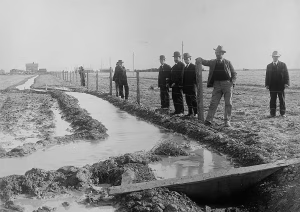
Everybody assumes Buffalo Bill founded Cody, Wyoming, as a tourist gateway to Yellowstone. That’s the story the town has told about itself for over a century, and there’s truth in it. It just isn’t the whole truth.
William F. Cody arrived in the Bighorn Basin in 1895 chasing an irrigation scheme, not a tourism play. He and his partners formed the Shoshone Land and Irrigation Company, hoping to water four hundred thousand acres of dry basin land under the Carey Act and build an agricultural empire to match his showman’s fortune. The dam was hard. The capital ran short. By 1916, broke and in poor health, Cody slipped out of Wyoming and died the following year at his sister’s home in Denver, the empire unbuilt.
What did work was the town itself, and the mythology Cody had spent thirty years perfecting on stages across two continents. His Wild West show, launched from an 1882 event in Nebraska he called the “Old Glory Blowout,” is often cited as the seed of American rodeo. It turned cowboys, sharpshooters, and staged Indian battles into the version of the frontier that most of the world still carries in its head, accurate or not.
That’s the tension worth sitting with in Cody today. This is a town built partly by a man who was, at the same time, one of the chief architects of Western mythology and one of the people most invested in preserving the real thing. The Buffalo Bill Center of the West, five museums under one roof, doesn’t shy away from that contradiction. It’s arguably the point.
Santa Fe: The West Before It Was American

Say “the West” to most people and they picture cattle drives and wagon trains. But the country around Santa Fe already held centuries of human history before the cattle drives and wagon trains of the popular Western imagination arrived.
Pueblo peoples were building communities in the Santa Fe area as early as the eleventh century. Spain established a colonial capital nearby in 1598 and moved it to present-day Santa Fe around 1610, thirteen years before Plymouth existed. For decades afterward, Spanish rule meant forced labor and religious suppression for the Pueblo communities of the region.
By 1680 they’d had enough. A Tewa leader named Po’Pay organized a coordinated uprising across dozens of pueblos, drove the Spanish colonists out of New Mexico entirely, and kept them out for twelve years. It remains one of the most successful Indigenous rebellions against a European power in North American history. It’s also a story most Americans have never heard.
The Spanish returned in 1692. Mexico took over after independence in 1821. The United States claimed the territory after the Mexican-American War. Santa Fe has now operated under five different flags, and the Palace of the Governors, built starting in 1610, has stood through every single one of them. It’s generally recognized as the oldest continuously occupied public building in the United States.
Walk the plaza today and that layering is still visible in the architecture, the language, and the roughly twenty Pueblo communities still occupying ancestral land within a hundred miles of the city. Santa Fe isn’t a prequel to the American West. It’s proof the West had a long life before America got there.
Dodge City: The Cattle-Trail Era, Concentrated

Dodge City’s reputation for violence has an origin story most people get backward.
The gunfighters and dance halls people picture belong to the cattle-drive years, roughly 1876 to 1886. A time when Wyatt Earp, Bat Masterson, and other names now etched onto souvenir shot glasses tried to keep order among cowboys fresh off the trail with money in their pockets. But the town’s genuinely wildest period came earlier, when Dodge was known as “Buffalo City.” Hide hunters flooded in behind the near-total slaughter of the Southern Plains bison herds, an estimated 850,000 hides shipped out between 1872 and 1874 alone, with leftover bones gathered by farmers and sold by the ton for fertilizer and china glaze. That trade, not the cattle trade, is what first earned the town its reputation for lawlessness.
A century later, Dodge’s reputation became so embedded in popular culture that “get out of Dodge” entered the American vocabulary, popularized by Western entertainment and especially Gunsmoke. The phrase wasn’t a relic of the cattle-trail era. It was another example of the legend growing larger than the history that created it.
By 1886 the drives had stopped and the boom was over. What lingers is worth noticing: an entire American archetype, the wild cattle town, was built almost entirely on about ten compressed years. Dodge City didn’t take long to become permanent in the American imagination. It just took long enough.
Deadwood: The Boomtown That Wasn’t Supposed to Exist

Most Western towns grew the way towns grow anywhere: a trading post, a rail spur, slow accretion over years. Deadwood erupted.
The land was Lakota territory, guaranteed by treaty in 1868. That didn’t stop rumors of gold from pulling prospectors north after George Armstrong Custer’s 1874 expedition into the Black Hills confirmed there was color in the creeks.
By 1876, tents and shanties were going up along Whitewood Creek almost overnight, an illegal settlement on land the United States had promised, on paper, to leave alone. There was no government, no sheriff, and for a while, no real law at all. Wild Bill Hickok was murdered at a card table there that same year. Calamity Jane became a fixture of the same rough streets.
What’s easy to miss under the outlaw mythology is how fast Deadwood turned into something more permanent and more industrial. The Homestake Mine, discovered nearby in 1876, was sold within a year to a group of San Francisco investors that included George Hearst. It grew into one of the largest, deepest gold mines in North American history, eventually becoming a listed company traded in New York. The frontier chaos and the corporate mining operation existed within a few years of each other, on the same ground, taken from the same broken promise.
Deadwood is proof that “the West” wasn’t a tidy line of wagon trains moving steadily toward the Pacific. Sometimes a town simply detonated into being, and the law, the money, and the mythology all had to catch up at once.
“There was never just one West. Ask ten towns what the West means and you’ll get ten different answers. All of them true.”
Pendleton: The Cowboy Culture Texas Never Owned

Ask most people to picture a cowboy and they’ll describe a Texan. Pendleton, Oregon, is a good corrective.
This is buckaroo country, a horsemanship tradition rooted in the vaquero practices of the Great Basin and Pacific Northwest rather than the Great Plains. Buckaroos favor rawhide braiding, the slow patience of the hackamore over the quick snaffle bit, and a mecate rein hand-twisted from horsehair. Techniques carried north from Spanish California generations ago. Still practiced by saddle and tack makers in town today.
The Pendleton Round-Up, running every September since 1910, is where that tradition performs itself for the world. And it’s produced one of the great, underappreciated stories in Western sport.
At the 1911 Round-Up, a Black cowboy named George Fletcher, a Nez Perce cowboy named Jackson Sundown, and a white cowboy named John Spain rode off in a three-way tie for the bronc-riding championship. The judges gave the title, and the prize saddle, to Spain. The crowd was furious. So furious that they passed the hat and bought Fletcher his own silver-mounted saddle on the spot. With it, they rendered a verdict from the grandstand that history has mostly sided with since. Not to be forgotten, Sundown finally won the championship outright in 1916, when he was already in his fifties.
Pendleton’s Round-Up parade, still one of the largest non-motorized parades in the country. The working saddle shops that have outfitted buckaroos since the 1880s. All of it makes the case that cowboy culture was never a single regional style. It had, and still has, a Northwest dialect all its own.
Bandera: Tradition, Deliberately Kept

Bandera calls itself the Cowboy Capital of the World. It’s fair to ask what that means for a town of under a thousand people. The honest answer says something bigger about how the West preserves itself.
The town started in 1853 as a cypress shingle mill on the Medina River. Two years later, sixteen Polish families arrived from Silesia to work it, building St. Stanislaus Catholic Church. The church, still standing, is the second-oldest Polish Catholic parish in the country. Cattle culture came later. Bandera became a staging ground on the Great Western Cattle Trail north to Dodge City through the 1870s and 1880s. And the ‘Cowboy Capital’ claim isn’t entirely promotional: Bandera and the surrounding Hill Country have produced an extraordinary number of rodeo competitors and champions for a community its size.
What’s worth thinking about isn’t whether Bandera’s cowboy identity is authentic. It’s what “authentic” even means in a place that has consciously, deliberately kept a tradition alive on purpose. It’s a place of dude ranches, weekly rodeos, and working horse culture. It’s been the living West for well over a century.
Tradition doesn’t stop being real just because a community decides to hold onto it. Bandera makes a decent argument that inheritance and intention aren’t opposites.
Tombstone: Where the Legend Overtook the History

Almost everything the popular imagination believes about the Gunfight at the OK Corral is slightly wrong. That gap between memory and record is the real story Tombstone has to tell.
The shootout on October 26, 1881, didn’t happen inside the OK Corral. It happened in a narrow lot roughly six doors down, and it lasted about thirty seconds. It wasn’t a fair fight between clearly defined good guys and bad guys.
Tombstone in 1881 was a silver boomtown, founded four years earlier by a prospector named Ed Schieffelin on ground he was warned would earn him nothing but his own tombstone. The town’s tensions ran partly along fault lines familiar from the postwar West: Northern Republican mining and business interests on one side, and Southern Democratic ranching interests, many with Texas roots, on the other. Wyatt Earp, Doc Holliday, and the Earp brothers weren’t simple lawmen facing down simple outlaws.
In the weeks after the gunfight, Wyatt rode out on what’s now called the Earp Vendetta Ride. It was during that ride, he killed several men connected to the other side without benefit of arrest or trial.
None of that nuance survived Hollywood’s version, which really begins with Stuart Lake’s heavily fictionalized 1931 biography of Wyatt Earp. That book, more than the event itself, built the white-hat legend that turned a messy thirty-second brawl into the defining image of frontier justice.
Tombstone’s mines flooded and its silver boom ended just five years after the gunfight. The town survived by mining the legend instead, and it still does. That makes Tombstone less a monument to what happened and more a monument to how a nation decides to remember what happened. And that might be the more interesting artifact.
Virginia City: Silver, Ambition, and a Newspaperman Who Became Mark Twain

Virginia City is proof the West wasn’t only cowboys and cattle. Sometimes it was capital, engineering, and an audacious amount of nerve.
The Comstock Lode, discovered in 1859, turned out to be one of the richest silver deposits ever discovered in North America. With it, Virginia City grew from a scatter of dirt-roofed mining shanties to a city of roughly twenty-five thousand people within fifteen years.
A community with more than a hundred saloons lining C Street and imported furniture arriving from Europe. Getting the silver out required real innovation. So, engineers developed a honeycombed timbering system to shore up mine shafts deeper than anyone had previously dug. When the lower levels flooded with scalding water, a tunnel builder named Adolph Sutro blasted a four-mile drain shaft straight through solid rock to save the mines.
The town’s most famous export wasn’t ore. In 1862, a failed prospector named Samuel Clemens took a job as a reporter for the local Territorial Enterprise. In February 1863, that prospector signed a column with a new name borrowed from his riverboat days, “Mark Twain.” His years covering the Comstock’s boom, and later writing about it in “Roughing It,” shaped the voice that would go on to define American literature.
Virginia City is worth a stop for anyone who thinks the frontier West was only a rural, agrarian place. This was an industrial boomtown. One wired into global capital markets, and more cosmopolitan than its remote location had any right to produce.
Taos: A Crossroads That Never Simplified
Taos resists the tidy version of Western history better than almost anywhere on this list. It’s place where three or four Wests are stacked on top of each other, and none of them ever fully replaced the one beneath it.
Taos Pueblo has been continuously inhabited for roughly a thousand years. Its multistoried adobe structures built between 1000 and 1450 A.D. and still lived in today, reveal a living community and a UNESCO World Heritage Site. Spanish colonists established a settlement nearby in the early 1600s. The friction between the two didn’t end with the 1680 Pueblo Revolt. Spanish forces returned in 1692 and put down further Taos Pueblo uprisings in 1696. And it’s this pattern of resistance and reconquest that shaped the valley for a century.
By the early 1800s, Taos had become a crossing point for mountain men and traders, Kit Carson among them. In fact, his adobe home here still stands. According to a long-standing Taos tradition, Confederate sympathizers repeatedly tried to remove the American flag from the plaza during the Civil War, prompting Union supporters to keep it guarded and flying around the clock.
Then, in 1898, two traveling artists named Bert Phillips and Ernest Blumenschein broke a wagon wheel on the road into town. They stayed to get it fixed, and never really left. Within two decades, Taos had become one of the country’s most influential art colonies. Home eventually to Georgia O’Keeffe and dozens of others drawn by the same light that had held those first two painters in place.
None of these layers, Pueblo, Spanish, mountain man, artist colony, canceled the others out. They just kept arriving on top of what was already there, which is as good a description of the actual West as any.

There Was Never Just One West
Notice what isn’t here. These aren’t necessarily the biggest towns in the West, or the oldest, or even the ones with the most name recognition. They’re places where the history is still close to the surface. Close enough that, if you know what you’re looking for, you can see how the West became what it is.
And ten towns could never tell the whole story. There are mining towns and ranch towns I left out, railroad towns and reservation communities, Spanish settlements and places where the cattle still outnumber the people. Ask me again next year and this list might look different.
And maybe that’s the point.
The West has never been one place or one story. It was shaped by Pueblo farmers and Spanish colonists, cattle drovers and miners, Native people and immigrants, ranchers and railroad men, artists and showmen. Some of them built communities. Others chased fortunes. And still others had the land taken out from under them. And all of them left something behind.
You can still find those layers if you’re willing to get off the interstate and look.
That’s what makes these towns worth visiting. Not because they’ve somehow been frozen in the Old West, but because they haven’t. They’ve changed, survived, adapted, and carried pieces of their past forward with them. And there are hundreds more out there like ’em. —☆
So which Western town would you add, and why? Make the case. We want the story, not just the name.
Ride Way Out West
Get stories of the American West, cowboy culture, and the traditions that still shape life on the range.

