

Editor’s Note: Historical records preserve several spellings, including Sacagawea and Sakakawea. For clarity, this article uses Sacajawea, the version most familiar to modern readers of Western history.
Some accounts say the Hidatsa raided a Shoshone village sometime around 1800, possibly along the upper Missouri or near the Three Forks of the Missouri in present-day Montana. Among those taken was a girl, ten or eleven years old, whose name in her own language was something closer to Boinaiv, or “Grass Woman.” The Hidatsa are said to have given her a different name, one historians still argue about.
Other accounts say that she was always Hidatsa on her father’s side and Crow on her mother’s. Was not kidnapped, and instead is said to have lived among her Crow mother’s family as a teenager.
The Story Before the Journals
Regardless of these conflicting accounts, one thing is clear: By the time Meriwether Lewis wrote her into his journal in November 1804, she had already passed through one life and into another. She was, Lewis noted without much comment, one of two wives of the French-Canadian trader Toussaint Charbonneau. Their’s was a relationship shaped by captivity, coercion, and the realities of the fur trade world.
That entry is worth sitting with. Lewis used the words plainly because it was a plain fact in the world he moved through. Sacajawea — the name Lewis and Clark would use — is commonly interpreted as meaning “Bird Woman,” but she was not a free agent. There is no evidence she was independently hired or volunteered in the modern sense.
When the Corps of Discovery departed Fort Mandan on April 7, 1805, she went because her husband went, and her husband went because he’d been engaged as an interpreter for the Hidatsa-speaking tribes ahead and because the Corps needed what the Hidatsa had: horses. Charbonneau saw economic opportunity prevalent among fur traders. She was sixteen years old and had given birth to her first child, Jean Baptiste, just two months before.
“She did not volunteer. She was not hired. When the Corps of Discovery departed, she went because her husband went.”
The popular image of Sacajawea single-handedly leading Lewis and Clark across the continent does not survive a close reading of the journals.
Lewis and Clark kept meticulous records. In those records, Sacajawea is rarely the agent of navigation. The trail through the mountains was already known to indigenous peoples. The captains made their directional decisions from astronomical readings, from interrogating local tribes, and from existing geographical reports. What Sacajawea provided was something more specific, and in its own way more remarkable: cultural currency and situational intelligence at critical moments.
What She Actually Did

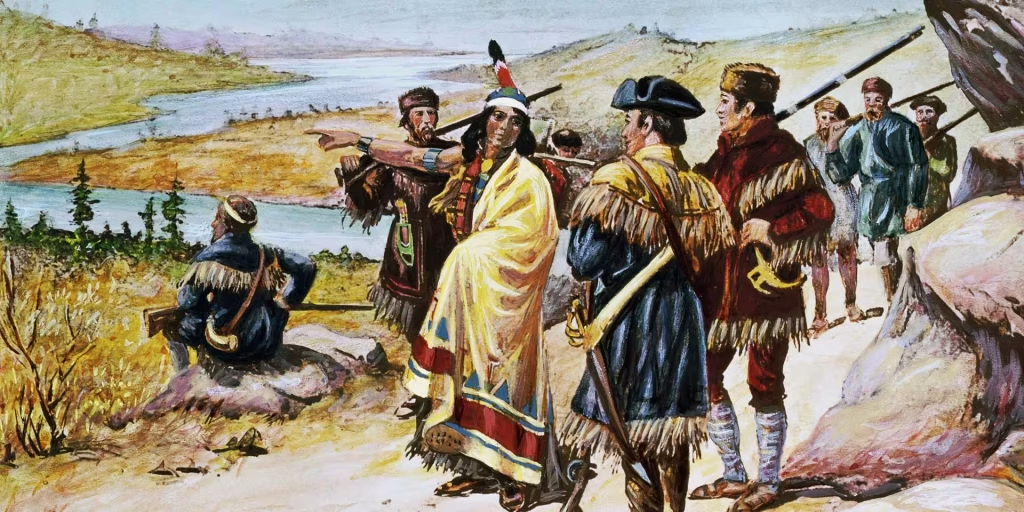
The most consequential moment of her involvement came in August 1805, at the continental divide in what is now Idaho. The Corps had reached the Shoshone, and without horses, they could not cross the mountains before winter. Lewis had gone ahead with a small party and encountered a band of Shoshone under a chief named Cameahwait. When Clark and the main party arrived with Sacajawea to interpret, she began to translate. And then stopped. She recognized the chief. He was her brother.
Lewis recorded the scene with his usual clinical attention: she threw her blanket over him and wept. The reunion did not make negotiations simple. Cameahwait was initially reluctant to commit his horses and men, aware that his village had enemies to the east.
But Sacajawea’s presence, her kinship, her ability to read what was being said beyond the words, almost certainly tipped the scale. They got the horses. They got a guide, a Shoshone man they called Old Toby.
Without that transaction, the Corps almost certainly would have wintered on the wrong side of the Rockies. Whether they would have survived is an open question.
She knew the country
Sacajawea, the journals note, also recognized landmarks as they traveled through her homeland. She told the captains which passes were passable, confirmed that a fork in a river led south toward familiar country. This is not nothing. But it is a far cry from blazing a trail through unknown wilderness.
She knew the land the way anyone knows the country where they were born and then stolen from. The knowledge was real. The mythology around it, the outstretched arm on the bronze statue, the torch raised toward the horizon, is something else.
The Woman in the Records
Clark, who had more warmth in his journals than Lewis, called her Janey. He grew fond of her son, whom he nicknamed Pompey, and later offered to raise the boy and give him an Anglo education — an offer Charbonneau and Sacajawea eventually accepted. What the journals reveal in aggregate is a young woman of considerable composure.
In May 1805, one of the pirogues nearly capsized in a squall. Charbonneau panicked at the helm. Sacajawea, sitting in the stern, calmly collected journals, instruments, medicines, and trade goods as they tumbled toward the river. Lewis and Clark both praised her for it. The same Lewis who, elsewhere in the journals, mentions her almost as an afterthought.
She is present at the vote, in November 1805, over where the Corps would winter near the Pacific. Clark recorded that every member of the party voted on the location, including York — Clark’s enslaved man — and Sacajawea.
It is a peculiar moment in American history: a Black man held in bondage and a Native woman held in a forced marriage both casting votes, long before either group would consistently enjoy full voting rights under American law. Whether they fully understood the gesture is unknowable. Whether it mattered to the outcome is doubtful. But Clark wrote it down, which means he thought it worth recording.
“Clark recorded that every member of the party voted, including York and Sacajawea — a peculiar moment in American history that the journals recorded and the monuments largely forgot.”
What the journals noticed
She also got sick. Seriously so, twice. In June 1805, near the Great Falls of the Missouri, she became ill enough that Lewis doubted she would survive and wrote about it with what reads like genuine concern — partly humanitarian, partly pragmatic, since he noted she was their only interpreter available for the Shoshone country ahead.
She recovered. The journals move on. That she gave birth, nursed an infant, fell ill, recovered, crossed the Bitterroot Mountains in October snow, and managed the sustained terror of that journey while surrounded almost entirely by men who regarded her as property is not a footnote. It is the story.
The Long Silence After

What happened to her after the expedition depends on which historical record you trust, and the records contradict each other sharply. The traditional account, long promoted and now contested, holds that she died at Fort Manuel in present-day South Dakota in December 1812, probably of typhus or another fever, at around twenty-five years old. A fur trader named John Luttig recorded the death of “the wife of Charbonneau, a Snake squaw” without using her name. That entry is the primary evidence for the early death theory.
The competing account of the Hidatsa holds that she lived for decades longer, returned to the Shoshone people, and died on the Wind River Reservation in Wyoming in 1884 at an advanced age. This version, maintained by the Eastern Shoshone themselves and supported by oral tradition and some documentary DNA evidence, has gained scholarly traction.
The Wyoming grave and marker exist. The Wind River Shoshone kept stories of her. A Shoshone woman named Porivo — meaning Chief Woman — who died at Wind River matches details of Sacajawea’s biography closely enough that several historians now take the long-life account seriously. Still, the debate is not settled.
The woman disappears from the record
What is settled is this: after the expedition, she largely vanished from the official record, which is what happened to people like her. The expedition journals were published. Lewis died in 1809 under circumstances that remain disputed.
Clark went on to become Superintendent of Indian Affairs, a position from which he oversaw policies that devastated the same tribes his journey had passed through. The Louisiana Purchase territory was organized, mapped, and eventually broken open for settlement. The Shoshone, the Hidatsa, the Mandan, the Nez Perce — the people the Corps of Discovery had moved among for two years, who had fed them and guided them and traded with them — spent the following decades losing their land.
What the Monument Gets Wrong

The statues came later. The first major Sacajawea monument was erected at the 1905 Lewis and Clark Centennial Exposition in Portland. The suffrage movement had adopted her as a symbol: a Native woman who, in their framing, had guided the nation toward its destiny. Susan B. Anthony and other leaders pointed to her as evidence of women’s capacity for public leadership. The impulse wasn’t malicious. The result, though, was a figure that bore little resemblance to the historical person.
The bronze woman with her arm outstretched is confident, purposeful, and forward-looking. The Sacajawea of the journals is none of those things, or rather, she may have been all of them internally, but the journals don’t record her interiority; they record her utility. She is a function. Pointing the way. Interpreting. Collecting the medicine chests.
She doesn’t speak in the journals beyond what others report. We don’t know what she thought about the Pacific when she finally saw it, whether she felt anything for the country she was traveling through or had been taken from. The journals, those meticulous logs of longitude and latitude and river depth, have almost nothing to tell us about what it was like to be her.
What we can actually know
Which may be the most honest thing to sit with. Sacajawea crossed a continent at sixteen, on foot and horseback and in canoes, with a newborn strapped to her, in the company of men who regarded her as a possession. She stood at the continental divide and recognized her brother across a distance she had no reason to expect to cross.
She is one of the most famous women in American history, and we know almost nothing about her that she herself chose to say. The monuments are guesses. The name on the dollar coin is probably not even in her language. What she actually did — hold it together, keep moving, manage the gap between worlds — doesn’t fit easily on a bronze plaque.
But it happened. In the high country above the Lemhi Pass, where the wind still carries the cold off the Idaho peaks even in August. The ground she walked is still there. That part, at least, is not a myth. —☆
Further Reading and Sources
This article draws from expedition journals, later historical scholarship, and Indigenous oral traditions surrounding Sacajawea. Readers interested in exploring the historical debate further may find these works valuable:
- The Journals of the Lewis and Clark Expedition, edited by Gary Moulton
- Lewis and Clark Among the Indians by James Ronda
- Sacajawea by Harold Howard
- Sacajawea of the Lewis and Clark Expedition by Ella E. Clark and Margot Edmonds
- The Making of Sacagawea by Donna Kessler
- Our Story of Eagle Woman, Sacagawea by tribal historians of the MHA Nation (proceeds support MHA Nation cultural programs)
Disclosure: Some of the links are affiliate links. If you choose to make a purchase, it helps support Way Out West. As an Amazon Associate, we earn from qualifying purchases.
Ride Way Out West
Stories of the American West, cowboy culture, and the traditions that still shape life on the range.

